
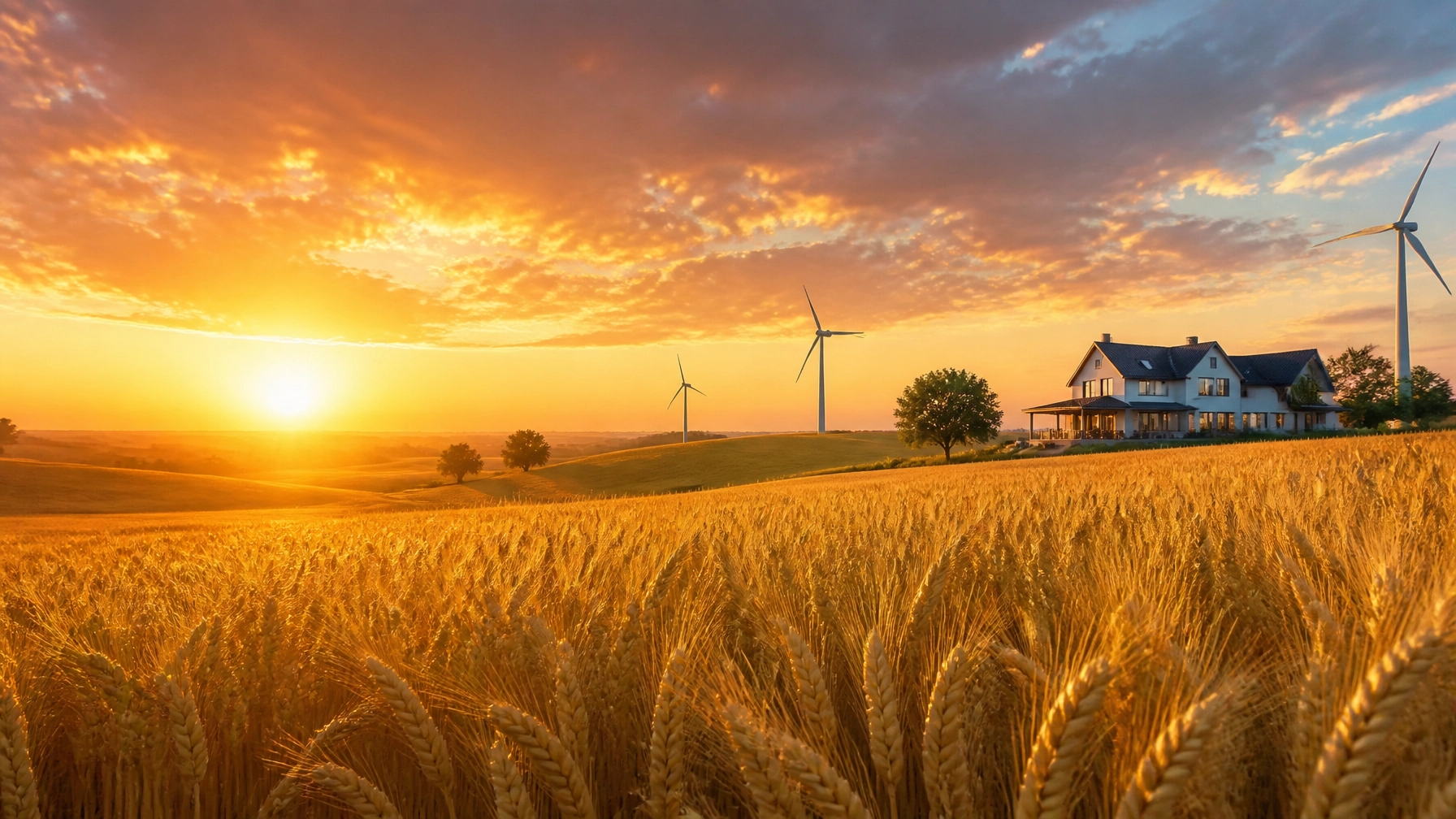
As we navigate the final quarters of 2026, the institutional real estate landscape is undergoing a profound structural shift. While the broader market has begun its stabilization phase following the volatility of the early 2020s, sophisticated investors: REITs, pension funds, and private equity firms: are looking toward 2027 with a refined focus on resilience and tax optimization.
The narrative for the 2025–2026 market recovery has been defined by wide sector dispersion. According to the MSCI Real Capital Analytics (RCA) CPPI, while national all-property indices showed modest year-over-year gains of +1.1% in early 2026, the underlying fundamentals tell a more nuanced story. The NCREIF Property Index (NPI) continues to highlight a persistent drag from the CBD office sector, where Net Operating Income (NOI) growth remains negative.
In this environment, farmland has emerged not just as a defensive play, but as the ultimate tax-efficient hedge. When combined with the upcoming Qualified Opportunity Zone (QOZ) 2.0 framework: codified by the One Big Beautiful Bill Act: investors have a historic opportunity to lock in gains within a permanent tax-saving vehicle.
The Resilience of Dirt: Why Farmland is Winning
Farmland is a finite asset in a growing world. While traditional commercial sectors struggled with vacancy and interest rate spikes, the agricultural sector demonstrated remarkable institutional health.
Data from the REALTORS® Land Institute (RLI) and the USDA reveals a startling resilience: despite a 50% drop in corn prices and a 60% drop in cotton prices during the 2022–2025 period, cropland values increased by 18%. This performance highlights a critical disconnect between short-term commodity cycles and the long-term value of the land itself.
Key Drivers for 2027:
- Finite Supply: The U.S. continues to lose approximately 4.8 acres of cropland every minute to development and infrastructure.
- Low Vacancy Risk: Unlike retail or office, productive farmland has effectively zero vacancy risk. Farmers require land to operate, ensuring consistent demand and lease income.
- Inflation Correlation: Historically, farmland returns have a positive correlation with inflation. As food costs rise, the value of the producing asset follows.
- Low Correlation to Equities: Farmland behaves differently than the standard 60/40 portfolio, providing a true diversifier that protects against systemic financial market risk.

Decoding QOZ 2.0: The "One Big Beautiful Bill" Act
The enactment of the One Big Beautiful Bill Act in July 2025 has renewed the Opportunity Zone program with a strategic pivot toward Rural Zones. While QOZ 1.0 remains valid for existing investments, QOZ 2.0 launches on January 1, 2027, introducing enhanced tax benefits specifically for rural and high-impact areas.
For institutional decision-makers, the timing is critical. The IRS nomination process for these new zones begins formally on July 1, 2026. This creates a high-stakes window for investors to identify and advocate for the designation of high-quality agricultural tracts that fit the new criteria.
The QOZ 2.0 Strategic Window:
- January 1, 2027: Official start of the QOZ 2.0 investment period.
- Rural Enhanced Benefits: The new bill offers deeper tax incentives for investments in rural census tracts, making the "Double-Dip" of farmland stability and OZ tax savings a reality.
- The Overlap: From 2027 through 2028, there will be a two-year overlap where investors can choose between 1.0 and 2.0 tracts, though version 2.0 is expected to have 25% fewer zones, increasing the scarcity and potential value of the new designations.
The "Double-Dip" Strategy: Combining Assets and Vehicles
The strategy is simple but requires expert execution: identify farmland opportunities that align with the projected QOZ 2.0 rural zones. By doing so, investors can achieve capital gain deferral until 2028 (or beyond, depending on final guidance) and, more importantly, permanent exclusion of gains on the appreciation of the land itself after a 10-year hold.
As MSCI RCA data suggests that cap rates in core commercial sectors have largely flattened, the alpha in 2027 will come from basis step-ups and tax-advantaged NOI growth. This is where the consultative approach of DontPayTax.com becomes indispensable.

DontPayTax.com: Your One-Source Partner for Complex Navigations
Navigating the transition from traditional commercial assets to specialized rural farmland OZs requires a single point of contact who understands both the real estate disposition and the complex tax mechanics.
At DontPayTax.com, we specialize in streamlining these multi-state strategies. Whether you are exiting a high-vacancy office portfolio or looking to deploy capital into the 2027 Rural Opportunity Zones, we provide the platform to optimize your strategy.
Our National Broker of Record (NBOR) Services are designed for the modern asset manager, offering:
- Streamlined Portfolio Management: Centralized control over dispositions and acquisitions across all 50 states.
- Discounted Commission Structures: Maximizing your net proceeds on the sale of legacy assets.
- Seamless Integration: Coordinating 1031 Exchanges with Opportunity Zone investments to ensure no tax leak during the transition.
Security is Paramount
When dealing with complex tax-deferred vehicles, the security of your capital is non-negotiable. At DontPayTax.com, security is paramount!
While our advisory covers a broad spectrum of real estate strategy, our 1031 exchange services are backed by industry-leading protections:
- $50M Fidelity Bond (applies strictly to the 1031 exchange process).
- $25M Errors & Omissions (E&O) Insurance.
- $20M Cyber Liability Insurance.
These protections ensure that as you pivot toward the 2027 Farmland/OZ frontier, your principal is shielded by the best-in-class compliance standards.

Action Items: The Road to July 2026
The nomination window is the most overlooked part of the OZ 2.0 cycle. Investors should not wait until 2027 to "find" deals. The work begins now:
- Audit Your Dispositions: Identify assets with significant capital gains that are underperforming according to the current NPI benchmarks.
- Target Rural Corridors: Use the time before July 1, 2026, to engage with local economic development agencies in prime agricultural regions.
- Consult the Experts: Schedule a session with DontPayTax.com to map out a multi-state disposition strategy that feeds directly into the new rural OZ 2.0 landscape.
Unless you have to pay tax, why would you? Discover how to transform your wealth by moving into the most stable asset class of the next decade.
Discover Your Strategy Today: Schedule a Consultation with DontPayTax.com