
Authority Statement: This strategic guide is authored by the senior advisory team at DontPayTax.com, leveraging over two decades of experience in high-stakes capital preservation. We provide institutional investors, REITs, and private equity firms with the technical framework necessary to navigate the intersection of IRC Section 1031 and accelerated depreciation under current 2026 Treasury regulations.
In the current fiscal landscape of April 2026, real estate investors are facing a unique "scissors" effect: rising valuations in specific sectors and the looming threat of depreciation recapture. As of this month, Industrial assets have seen a +3.7% YoY increase, while the Multifamily sector continues its robust recovery, according to the NCREIF Property Index (NPI). However, with these gains comes a massive tax liability, unless you have a plan.
The "Double Play", the integration of a 1031 Exchange with a Cost Segregation Study, remains the gold standard for sophisticated wealth preservation. At DontPayTax.com, we specialize in transforming these complex tax hurdles into opportunity capital.
Can you do a cost segregation study on a 1031 exchange property?
The short answer is yes, but the execution requires surgical precision regarding basis allocation. While a 1031 exchange allows you to defer capital gains and depreciation recapture, a cost segregation study on the replacement property allows you to "front-load" depreciation deductions to offset ordinary income.
When these two strategies are integrated, you aren't just deferring taxes; you are actively creating a massive tax shield that can wipe out the tax liability on the cash flow of your new acquisition. In 2026, this is more critical than ever as institutional players use these deductions to hedge against corrections in the Office and Retail sectors.

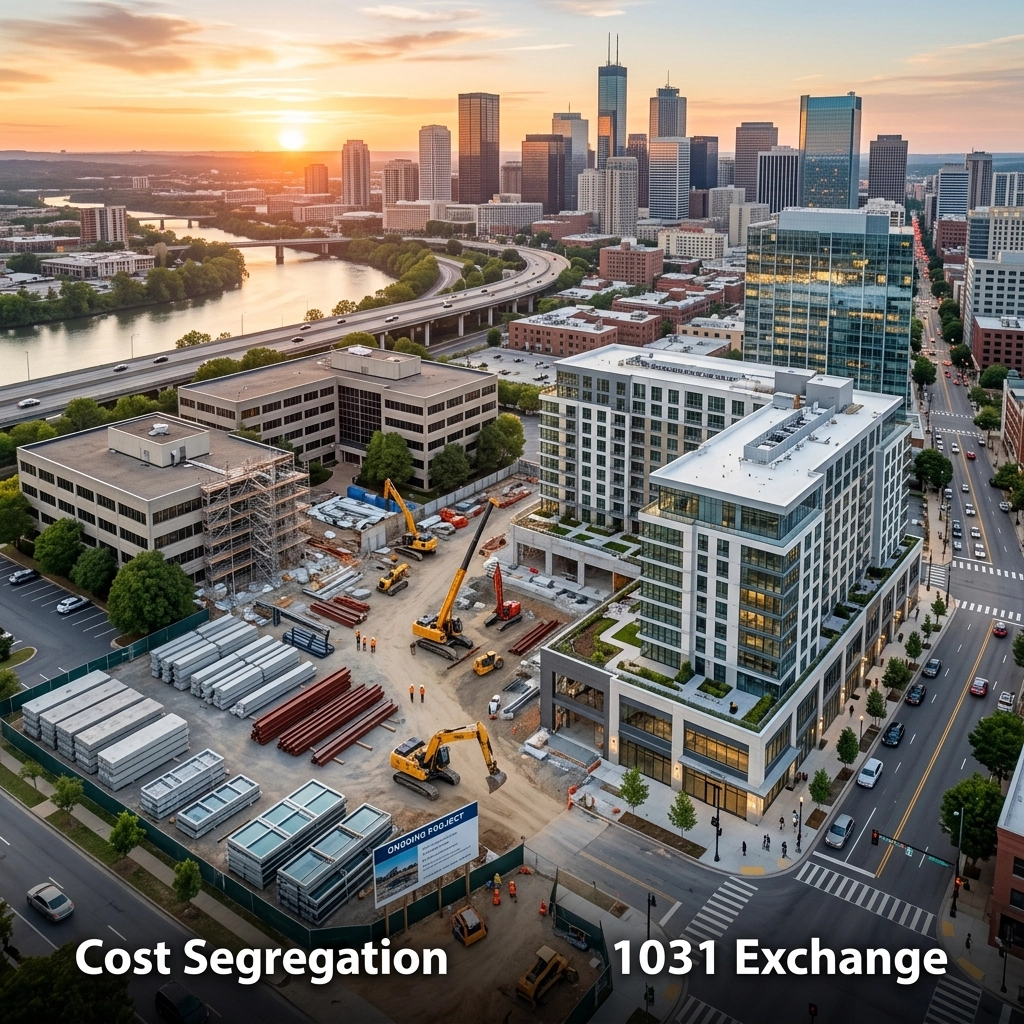
Caption: Combining tax deferral with tax acceleration creates a synergistic effect on IRR.
The Technical Mechanics: Exchanged Basis vs. Excess Basis
To master this integration, you must understand Treasury Reg. 1.168(i)-6, which dictates how depreciation carries over in a like-kind exchange. Your replacement property’s total basis is generally split into two distinct buckets:
- Exchanged Basis (Carryover Basis): This is the adjusted basis of the property you sold. Under the tax code, you continue to depreciate this portion over the remaining life of the original asset. For example, if you sold a warehouse with 10 years of depreciation left, that basis continues on a 10-year track.
- Excess Basis: This is any "new" value added to the deal: typically through additional cash investment or increased debt.
Cost segregation applies to both. However, the treatment of these buckets differs significantly under the One Hundred Percent Bonus Basis Amendment (OBBBA) of 2026.
How does cost segregation affect 1031 exchange basis?
Cost segregation reclassifies building components (like specialty lighting, flooring, and landscaping) from 27.5- or 39-year real property into 5-, 7-, or 15-year personal property.
The impact on basis is profound. By performing a study, you can reallocate a significant portion of the Exchanged Basis into shorter-life categories. This accelerates the "tail" of the depreciation you were already taking.
More importantly, the Excess Basis: the new capital you’ve brought into the deal: is eligible for 100% Bonus Depreciation under the OBBBA 2026 guidelines for assets placed in service this year. This allows for an immediate, first-year write-off of all qualifying 5-, 7-, and 15-year assets within that excess basis portion.
Solving the Recapture Trap: Section 1245 vs. Section 1250
One of the primary concerns for investors is Depreciation Recapture. When you sell a property, the IRS wants a piece of the depreciation you previously claimed:
- Section 1250 Depreciation: Recaptured at a maximum rate of 25%.
- Section 1245 Depreciation: (Personal property identified via cost segregation) Recaptured at ordinary income rates, which in 2026 can be as high as 37%.
The beauty of the 1031 exchange is that it defers both. By performing a 1031 exchange into a new property, you move the recapture liability forward, avoiding the tax hit today. By then layering a cost segregation study on the new property, you generate new 1245 deductions to offset current income. You are essentially trading old, "used" depreciation for new, "high-value" deductions.
Unless you have to pay, why would you? Our team at DontPayTax.com ensures that the allocation of Section 1245 property is balanced across the exchange to maximize your "Step-In-The-Shoes" depreciation while keeping your tax shield intact.
What are the benefits of combining 1031 exchanges with cost segregation?
The integration of these strategies offers three primary institutional advantages:
- Increased Cash-on-Cash Return: By reducing your tax liability to near zero in the first few years of ownership, you effectively increase the yield on your investment.
- Capital Recycling: The tax savings generated can be reinvested into property improvements or used as a down payment on additional acquisitions, accelerating portfolio growth.
- Risk Mitigation: In an era of market volatility, having a robust tax shield provides a margin of safety against fluctuating Net Operating Income (NOI).
According to MSCI Real Capital Analytics (RCA) CPPI data, transaction pricing in the industrial sector remains aggressive. Investors who utilize 1031 exchange and accelerated depreciation are able to outbid competitors because their after-tax ROI is significantly higher.

Market Context: Institutional Health in 2026
The 2026 market recovery is uneven. While Industrial and Multifamily are the darlings of the NPI benchmarks, Office and certain Retail segments are still undergoing structural corrections. For Pension Funds and REITs, the ability to harvest gains from high-performing assets via a 1031 exchange and "reset" the depreciation clock on a replacement asset is a vital survival mechanism.
Strategic moves involve exiting high-valuation, low-yield industrial plays and entering value-add multifamily projects where cost segregation can unlock immediate capital for renovations.
National Broker of Record (NBOR) Services: A Seamless Move
Managing a 1031 exchange across multiple states while coordinating engineering-based cost segregation studies is a logistical minefield. This is why DontPayTax.com offers National Broker of Record (NBOR) Services.
We act as your one-source, single point of contact for full-service real estate investment management and tax savings solutions. Our NBOR services deliver:
- Streamlined Portfolio Management: We handle multi-state dispositions with a unified strategy.
- Discounted Commission Structures: Optimized for institutional-scale transactions.
- Best-in-Class Security: At DontPayTax.com, security is paramount!
Our 1031 exchange services are backed by best-in-class protections: $50M Fidelity bond (applies strictly to the 1031 exchange process), $25M E&O, and $20M Cyber liability insurance. This level of protection is unmatched in the industry and ensures your exchange funds are shielded from risk during the identification and closing periods.

Caption: Secure your capital with industry-leading bonds and insurance protocols.
Avoiding the "Blown" Exchange
Many investors fail to integrate these strategies because of timing errors or poor documentation. A blown 1031 exchange can be a multi-million dollar disaster. By engaging our Nationwide Tax Referral Network, you gain access to the CPAs and attorneys who understand the nuance of the 2026 OBBBA regulations.
Don't leave your wealth to chance. Whether you are dealing with a complex Delaware Statutory Trust (DST) or a standard fee-simple exchange, the integration of cost segregation is the key to unlocking the full potential of your real estate portfolio.
Conclusion: Take the Strategic Next Step
The window for 100% bonus depreciation under the current OBBBA framework is a powerful incentive for those closing deals in April 2026. By combining the deferral power of Section 1031 with the acceleration power of cost segregation, you aren't just following the law: you are mastering it.
Ready to maximize your next acquisition?
Discover how our institutional-grade strategies can transform your tax liability into opportunity capital.
- Explore our 1031 Exit Strategies
- Learn about our Creative 1031 and Opportunity Zone Strategies
- Contact us for a preliminary Cost Segregation Analysis
At DontPayTax.com, security is paramount! Let’s build your tax shield today. Unless you have to!